Stress vs Strain Explained From First Principles
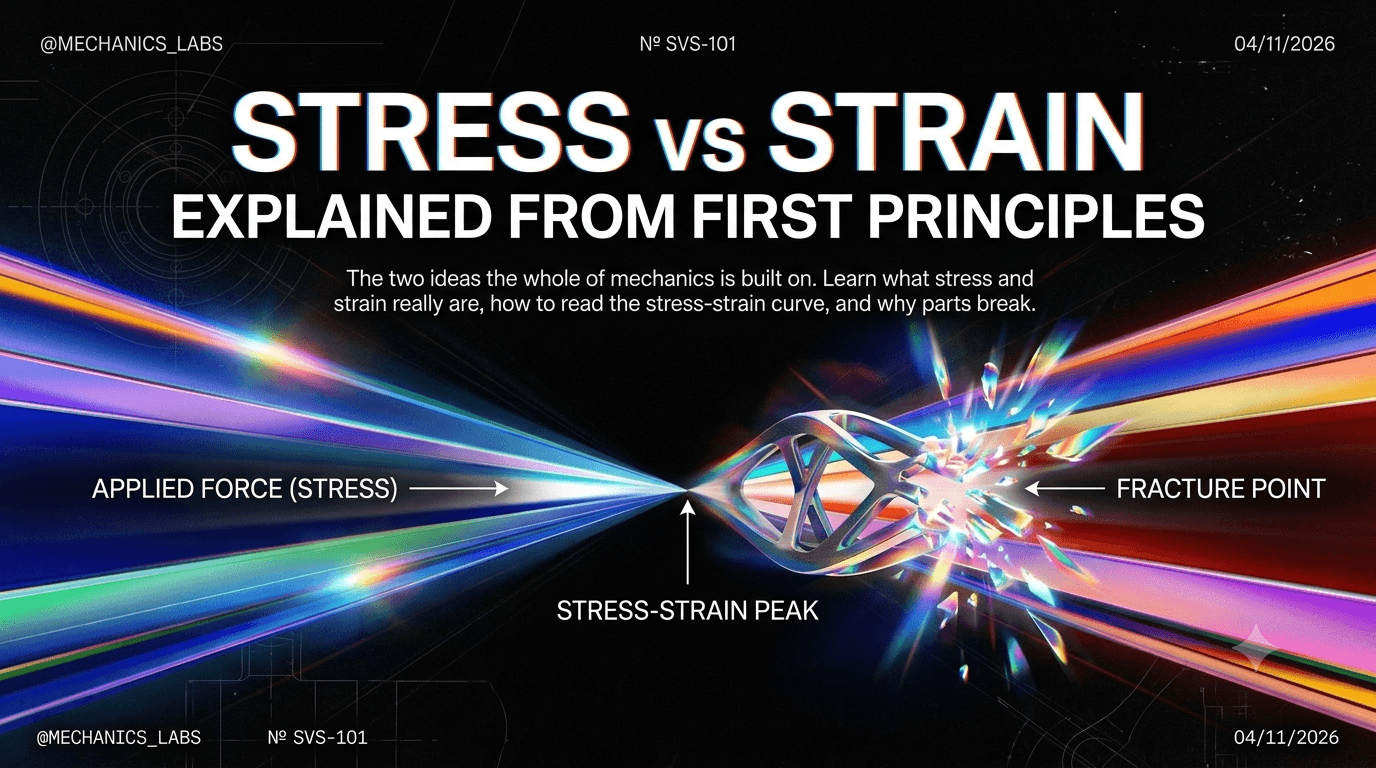
The two ideas the whole of mechanics is built on. Learn what stress and strain really are, how to read the stress-strain curve, and why parts break.
On this page
Stress vs Strain Explained From First Principles
The two ideas that the whole of mechanics is built on
What are stress and strain?
Stress is the internal force inside a material spread over the area carrying it. Strain is how much the material stretches or squashes compared to its original length.
Put simply, stress is what the material feels, and strain is how much it moves in response. Every calculation about whether a part will break, bend, or survive traces back to these two ideas. Get them clear and the rest of mechanics has a foundation. Confuse them, and nothing after this will make sense.
Why this matters
Stress and strain are how engineers turn a vague worry like "will this hold?" into a number they can check.
A load on a part creates stress inside it. If that stress climbs past what the material can take, the part fails. The strain tells you how much the part deforms along the way, which matters just as much when a part must stay in shape. Bridges, engine mounts, phone cases, and bones all live or die by these two quantities.
Building it from first principles
Imagine pulling on a metal bar.
The force does not act at a single point. It spreads across the bar's cross-section. Stress is that force divided by the area it acts on.
- Stress = Force / Area. A thin bar under the same force feels more stress than a thick one, because the same force is packed into less area. This is why stress, not force, predicts failure.
As you pull, the bar also gets slightly longer. Strain measures that stretch relative to the original length.
- Strain = Change in length / Original length. It has no units, because it is a length divided by a length. A strain of 0.001 means the bar stretched by one tenth of one percent.
The stress-strain curve
If you pull a sample steadily and plot stress against strain, you get the single most important graph in mechanics.
Reading it from the start:
- Elastic region. At first, stress and strain rise together in a straight line. Remove the load here and the material springs back to its original shape. The slope of this line is the material's stiffness, called the modulus.
- Yield point. Push past this and the material starts to deform permanently. It will not fully spring back anymore.
- Ultimate strength. The highest stress the material can take.
- Fracture. Where it finally breaks.
The straight elastic part follows a simple rule: stress equals stiffness times strain. This is Hooke's law, and it governs almost every part operating safely below its yield point.
💡 Rule of thumb: the slope of the curve is stiffness, and the height of the curve is strength. They are two different things, which is why we have a whole separate guide on stiffness vs strength.
Ductile and brittle behaviour
Not every material fails the same way, and the curve shows it.
- Ductile materials like mild steel and aluminium stretch a lot after yielding before they break. They give warning. You see the part deform before it fails.
- Brittle materials like cast iron, glass, and ceramics snap with almost no warning, breaking soon after the elastic region ends.
This difference drives real design choices. A ductile part bends and warns you. A brittle part just breaks, so you design it with far more margin.
A quick worked example
A steel rod with a cross-section of 100 square millimetres carries a pull of 20,000 newtons.
- Stress is force over area: 20,000 divided by 100, which is 200 newtons per square millimetre.
- If the rod is 2 metres long and stretches by 2 millimetres, the strain is 2 divided by 2,000, which is 0.001.
Compare the 200 stress figure against steel's yield strength of around 250. The rod is loaded but still safely elastic, and it will spring back when the load is removed.
Common beginner mistakes
- Confusing stress with force. Force is the load, stress is force spread over area.
- Confusing stress with strain. Stress is what the material feels, strain is how much it moves.
- Forgetting that strain has no units.
- Assuming a material always springs back. Past the yield point it does not.
Interview questions
These test whether you understand the foundation or just memorised formulas. Here is what interviewers listen for.
"What is the difference between stress and strain?" Stress is internal force per unit area. Strain is deformation per unit length. One is what the material feels, the other is how much it moves.
"Why do we use stress instead of force to predict failure?" Because the same force is more dangerous in a thin part than a thick one. Stress accounts for the area carrying the load, so it reflects what the material actually experiences.
"What does the slope of the elastic region tell you?" The material's stiffness, its modulus. A steeper slope means a stiffer material that deflects less under the same stress.
"How can you tell a ductile material from a brittle one on the curve?" Ductile materials show a long stretch after yielding before fracture. Brittle materials break shortly after the elastic region with little deformation.
Quick reference
| Term | Meaning | Formula |
|---|---|---|
| Stress | Internal force per area | Force / Area |
| Strain | Deformation per length | Change in length / Original length |
| Modulus | Stiffness, slope of elastic line | Stress / Strain |
| Yield strength | Stress where permanent deformation starts | Read from curve |
| Ultimate strength | Highest stress before failure | Read from curve |
Key takeaways
If you remember five things, make it these.
- Stress is force spread over area, which is why it, not force, predicts failure.
- Strain is deformation over length, and it has no units.
- The stress-strain curve is the master graph of mechanics, showing elastic, yield, ultimate, and fracture.
- Slope is stiffness, height is strength. They are independent.
- Ductile materials warn you, brittle ones do not, which changes how much margin you design in.
Practice on FixtureLabs
These ideas stick once you calculate with them. On FixtureLabs, work through problems that ask you to find stress, strain, and where a part sits on its curve before it ever reaches yield.
Written by
FixtureLabs Inc.
FixtureLabs Inc. writes about fixture design, GD&T and how modern teams pair classical mechanical engineering with AI.