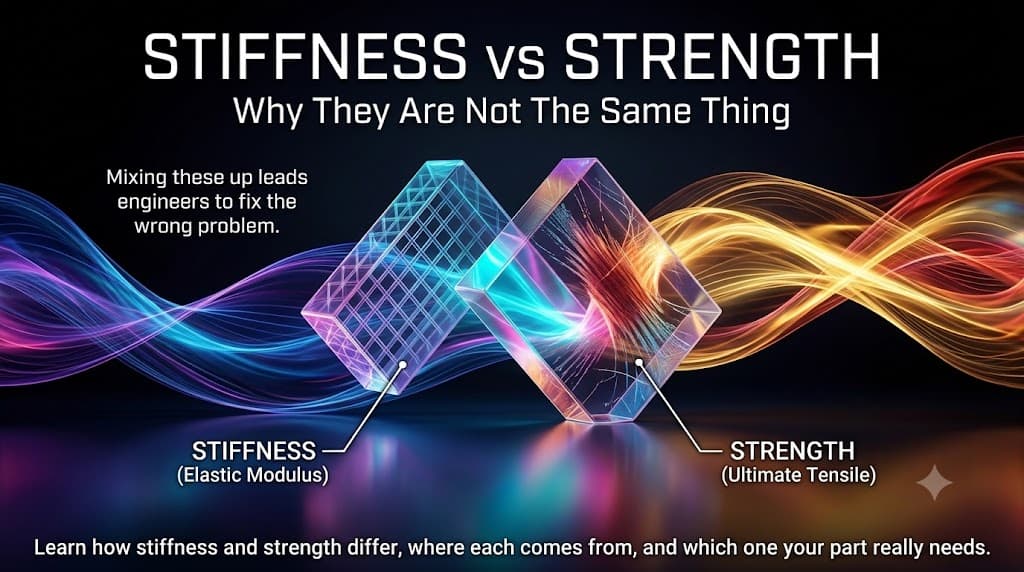
Stiffness vs Strength: Why They Are Not the Same Thing
Mixing these up leads engineers to fix the wrong problem. Learn how stiffness and strength differ, where each comes from, and which one your part really needs.
On this page
Stiffness vs Strength: Why They Are Not the Same Thing
The mix-up that leads engineers to fix the wrong problem
What are stiffness and strength?
Stiffness is how much a part resists bending or stretching under load. Strength is how much load a part can take before it permanently deforms or breaks.
They sound similar, and beginners treat them as the same thing, but they are completely independent. A part can be stiff and weak, like glass, which barely bends but shatters easily. Or it can be strong and flexible, like a fishing rod, which bends dramatically without breaking. Knowing which one your part actually needs is one of the most useful instincts in engineering.
Why this matters
Confuse the two and you fix the wrong problem, often at real cost.
Say a bracket bends too much in service. The instinct is to reach for a stronger material. But bending is a stiffness problem, and most metals have similar stiffness regardless of strength. Swapping mild steel for a high-strength alloy barely changes how much it bends. You would spend more money and see almost no improvement. The right move is to change the stiffness, through shape or material, not the strength.
Building the intuition
Picture a diving board.
- When you stand on the end and it sags, that sag is about stiffness. A stiffer board sags less.
- If you jumped hard enough to snap it, that would be about strength. A stronger board takes more force before it breaks.
These are separate questions. How much it bends is stiffness. How much it takes before failing is strength. A board can be very stiff but snap suddenly, or very bendy but almost impossible to break.
Rubber is strong enough to stretch far without tearing, yet has almost no stiffness. Glass is extremely stiff, holding its shape under load, yet is weak and shatters. The two properties simply do not track each other.
Where each one comes from
This is the part that unlocks it.
On a stress-strain curve, stiffness is the slope of the elastic line, and strength is the height where the material yields or breaks. Different things entirely. See our stress vs strain guide for the full curve.
But stiffness has a second source that surprises people: shape. A part's resistance to bending depends not just on the material but heavily on how the material is arranged.
This is why an I-beam exists. The same amount of steel, moved away from the centre and into the top and bottom flanges, resists bending far better than a solid bar of the same weight. You can make a part much stiffer without changing material at all, just by changing its cross-section. Strength does not work this way in the same manner, which is another reason to keep the two ideas separate.
🤔 Design decision: a part flexes too much under load. Do you pick a stronger material? No. Flexing is stiffness. Change the shape to move material away from the bending axis, or pick a stiffer material. A stronger but equally stiff material will flex just as much.
A quick worked example
A shelf sags too much when loaded. Two fixes present themselves.
- Stronger material. Swap the wood for a high-strength alloy of similar stiffness. The shelf still sags almost the same, because you changed strength, not stiffness. Wasted money.
- Stiffer shape. Add a lip along the front edge, turning a flat plank into an L-shaped section. The sag drops sharply, because you moved material away from the bending axis and raised the stiffness.
The second fix works because it targets the real property. The sag was never a strength problem.
Common beginner mistakes
- Treating a bending problem as a strength problem
- Assuming a stronger material is always a stiffer one
- Forgetting that shape drives stiffness as much as material does
- Over-specifying strong, expensive materials to solve deflection
Interview questions
This distinction is a favourite because it instantly separates deep understanding from surface memorisation. Here is what they listen for.
"What is the difference between stiffness and strength?" Stiffness is resistance to deflection. Strength is resistance to permanent deformation or failure. They are independent properties.
"A part deflects too much. How do you fix it?" Increase stiffness, not strength. Change the shape to resist bending better, or choose a stiffer material. A stronger material of similar stiffness will not help.
"Does a stronger material mean a stiffer one?" No. Many high-strength alloys have almost the same stiffness as ordinary steel. Strength and stiffness do not track together.
"Why does an I-beam use its shape the way it does?" Because moving material away from the bending axis raises stiffness for the same weight, resisting deflection far more efficiently than a solid bar.
Quick reference
| Property | What it resists | Comes from |
|---|---|---|
| Stiffness | Bending and stretching | Material modulus and shape |
| Strength | Permanent deformation and breaking | Material stress limit |
| Fix for deflection | Change stiffness | Stiffer shape or material |
| Fix for breaking | Change strength | Stronger material or more area |
Key takeaways
If you remember five things, make it these.
- Stiffness resists bending, strength resists breaking. They are independent.
- A stronger material is not automatically a stiffer one.
- Stiffness comes from shape as much as material, which is why the I-beam exists.
- A deflection problem is a stiffness problem, so change shape or modulus, not strength.
- Knowing which one a part needs stops you from fixing the wrong thing.
Practice on FixtureLabs
This instinct sharpens with practice on real parts. On FixtureLabs, work through problems that ask whether a part needs more strength or more stiffness, and prove it with the numbers.
Written by
FixtureLabs Inc.
FixtureLabs Inc. writes about fixture design, GD&T and how modern teams pair classical mechanical engineering with AI.