Material Selection 101: How to Choose the Right Metal or Plastic
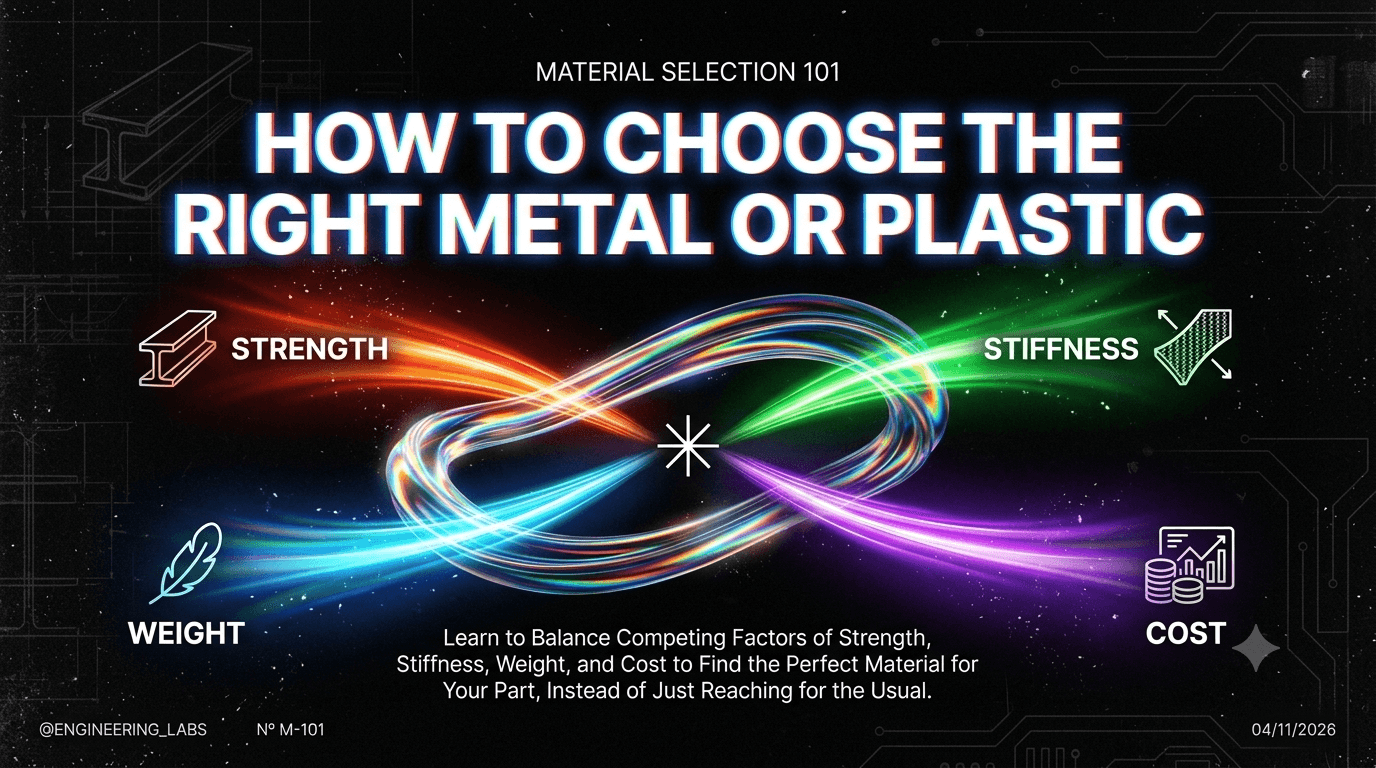
Strength, stiffness, weight, and cost all pull in different directions. Learn how to choose the material that fits your part instead of the one you always reach for.
On this page
- How to choose the right metal or plastic for a part
- What is material selection?
- Why it matters
- Start with the requirements
- The properties that matter most
- Metals versus plastics
- The tradeoff mindset
- A common-materials cheat list
- A quick worked example
- Common beginner mistakes
- Interview questions
- Key takeaways
- Practice on FixtureLabs
Material Selection 101
How to choose the right metal or plastic for a part
What is material selection?
Material selection is the job of choosing the material whose properties best match what a part needs to do, without over-building it or under-building it.
It sounds simple, but it is one of the decisions that quietly makes or breaks a design. The same bracket in the wrong material can be too heavy, too weak, too expensive, or impossible to make. Pick well and the part is light, strong enough, affordable, and easy to produce. Pick by habit and you get a part that works on paper but fails in the real world.
Why it matters
The material sets the ceiling for almost everything else about the part.
- Performance. How much load it carries, how much it bends, how long it lasts.
- Weight. A drone or a car cares deeply about every gram.
- Cost. Raw material and the cost to shape it.
- Manufacturability. Some materials machine easily, some mold beautifully, some do neither.
- Environment. Heat, moisture, chemicals, and sunlight destroy the wrong material fast.
Choose the material last and you are stuck retrofitting the part to whatever you picked. Choose it alongside the design and the whole part gets easier.
Start with the requirements
You cannot choose a material until you know what the part must survive. Before looking at any material, write down the demands.
- What loads does it carry, and in what direction?
- How stiff must it be, meaning how little can it bend?
- Is there a weight limit?
- What is the budget, and how many will you make?
- What environment does it live in? Heat, water, chemicals, sunlight?
- How will it be manufactured?
The material that wins is the one that meets these at the lowest cost and weight. Not the strongest, not the fanciest. The best fit.
The properties that matter most
A few properties do most of the work in a first material choice.
- Strength is the stress a material takes before it yields or breaks. It sets whether the part survives its load.
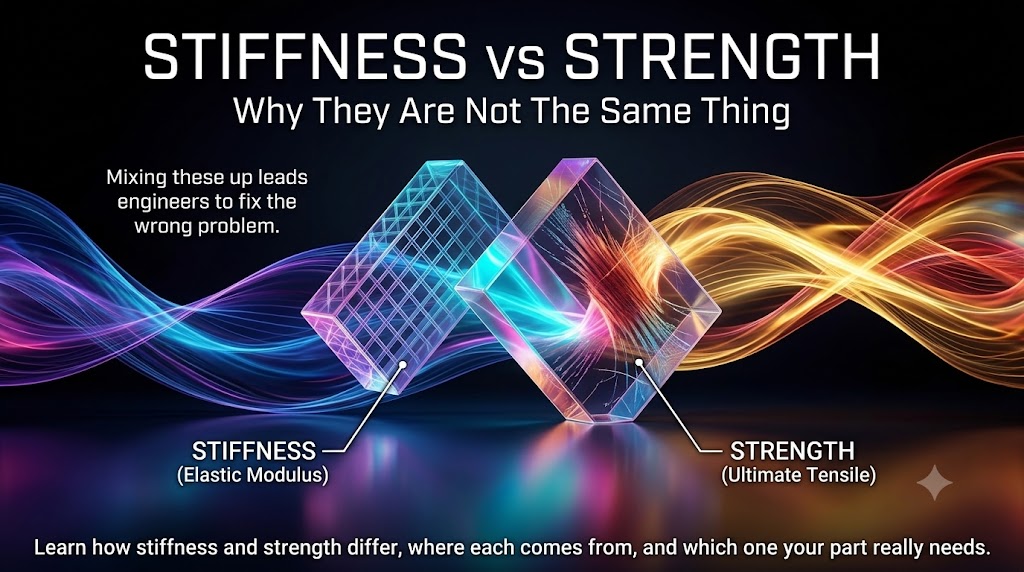
- Stiffness, or modulus, is how much it bends under load. This is a different property from strength, and confusing the two is the most common beginner mistake. A part can be strong but flexible, or stiff but brittle. See our guide on stiffness vs strength for why.
- Density sets the weight for a given shape. It drives every weight-critical design.
- Toughness is resistance to cracking and sudden fracture.
- Corrosion and temperature resistance decide whether the material survives its environment.
- Cost and availability decide whether the design is realistic at all.
Metals versus plastics
The first fork in most decisions is metal or plastic. Each has a character.
- Metals are strong, stiff, tolerate heat, and conduct. They are heavier and often cost more to shape. Reach for them when loads are high, stiffness matters, or heat is present.
- Plastics are light, cheap in high volume, resist corrosion, and mold into complex shapes in one shot. They are less strong and less stiff, and they soften with heat. Reach for them for light, high-volume, low-load, or corrosion-prone parts.
Neither is better. They are tools for different jobs.
The tradeoff mindset
There is no perfect material. Every one is a bundle of compromises, and your job is to pick the best compromise for the property that drives your part.
This is why engineers think in ratios, not raw numbers. If weight is the enemy, you do not want the strongest material, you want the best strength for its weight. Aluminium beats steel on strength-to-weight even though steel is stronger overall. Carbon fibre beats both. The winner depends entirely on which requirement is driving the design.
🤔 Design decision: a part is failing because it bends too much, not because it breaks. Do you switch to a stronger material? No. Bending is a stiffness problem. A stronger but equally stiff material will bend just the same. You need a stiffer material or a stiffer shape.
A common-materials cheat list
A rough starting point for everyday parts.
| Material | Good for | Watch out for |
|---|---|---|
| Aluminium | Light, stiff enough, easy to machine | Softer, lower strength than steel |
| Mild steel | Cheap, strong, easy to weld | Heavy, rusts without coating |
| Stainless steel | Corrosion resistance, strength | Cost, harder to machine |
| Titanium | High strength-to-weight, corrosion | Expensive, hard to machine |
| ABS plastic | Cheap, tough, easy to mold | Low heat and load limits |
| Nylon | Wear resistance, toughness | Absorbs moisture |
| Polycarbonate | Impact resistance, clarity | Scratches, cost |
A quick worked example
Design a drone arm. The requirements: light above all, stiff so it does not flex in flight, low load, made in modest quantity.
Weight and stiffness drive this, so you want the best stiffness-to-weight. Steel is out, far too heavy. Aluminium works and is easy to machine. Carbon fibre is even better if the budget and process allow. The strongest material, titanium, is the wrong answer here, because strength was never the problem.
Common beginner mistakes
- Picking a material out of habit rather than from requirements
- Confusing strength and stiffness
- Ignoring how the material will be manufactured and what it costs
- Reaching for titanium or exotic materials when aluminium would do
- Forgetting the environment the part lives in
Interview questions
Material questions show whether you reason from requirements or just recall a table. Here is what interviewers listen for.
"How would you choose a material for this part?" Start from requirements: loads, stiffness, weight, environment, cost, and process. Then match, and pick the best fit rather than the strongest option.
"What is the difference between strength and stiffness?" Strength is the stress before failure. Stiffness is resistance to bending. They are independent, and mixing them up leads to the wrong material.
"Why not just use the strongest material available?" Because strength is rarely the only driver, and the strongest materials are usually heavier, costlier, or harder to make. The best material is the best fit, not the strongest.
"Metal or plastic for a high-volume, low-load housing, and why?" Plastic, most likely. It is light, cheap at volume, corrosion resistant, and molds complex shapes in one step.
Key takeaways
If you remember five things, make it these.
- Start from requirements, not from a favourite material. The best material is the best fit.
- Strength and stiffness are different properties. Know which one your part actually needs.
- Think in ratios like strength-to-weight when weight or stiffness drives the design.
- Metals and plastics are tools for different jobs, not better or worse.
- Never ignore cost, manufacturing, and environment. They rule out more materials than strength ever does.
Practice on FixtureLabs
Material choices click when you make them against real constraints. On FixtureLabs, work through problems that ask you to weigh strength, stiffness, weight, and cost and defend the material you pick.
Written by
FixtureLabs Inc.
FixtureLabs Inc. writes about fixture design, GD&T and how modern teams pair classical mechanical engineering with AI.