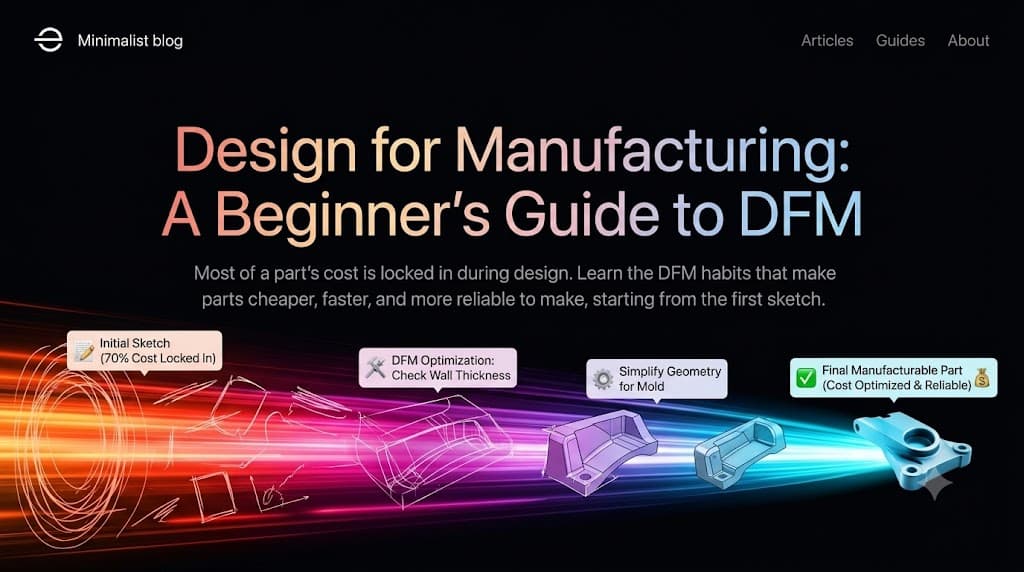
Design for Manufacturing: A Beginner's Guide to DFM
Most of a part's cost is locked in during design. Learn the DFM habits that make parts cheaper, faster, and more reliable to make, starting from the first sketch.
On this page
Design for Manufacturing (DFM)
Designing parts that are cheap, fast, and reliable to make
What is DFM?
Design for Manufacturing is the practice of shaping a part so it is simple, cheap, and reliable to produce, by matching the design to the realities of the process while the design is still on the screen.
It is not a step you do at the end. It is a mindset you carry from the first sketch. Two parts can do exactly the same job, yet one costs three times as much to make because of choices that were invisible in the CAD model. DFM is how you end up with the cheaper one on purpose.
Why DFM matters
Most of a part's cost is decided long before anyone makes it. By the time the design is finished, the material, the process, the number of features, and the tolerances are all locked in, and those choices set the price.
The other reason to care is the cost of changing your mind. A change during design is a few clicks. The same change after tooling is ordered can mean scrapped molds and weeks of delay. Getting it right early is not just cheaper to make, it is cheaper to fix.
💡 Rule of thumb: the best time to cut manufacturing cost is before the first prototype, not after.
The core DFM principles
Most of DFM comes down to a handful of habits that apply no matter what you are making.
- Reduce the part count. Every part is another thing to make, stock, and assemble. Combining two parts into one often removes a fastener and an assembly step as well.
- Use standard components. Standard screws, bearings, and stock sizes are cheaper, faster to get, and easy to replace.
- Design for the chosen process. Match features to how the part will be made, so nothing needs a special setup or tool.
- Loosen tolerances where you can. Tight tolerances cost money. Ask for them only where a part must fit or mate.
- Design for easy assembly. Fewer fasteners, parts that only go in one way, and features that guide themselves into place.
- Avoid features you do not need. Every extra pocket, finish, and tight surface adds time and cost.
A few process rules worth knowing
Each process rewards different choices. You do not need to memorise them all, but a few show up constantly.
- Machining. Fillet internal corners, use standard holes, and reduce the number of setups by keeping features on as few faces as possible.
- Injection molding. Add draft so the part releases, keep walls uniform to avoid warping, and use ribs instead of thick sections.
- Sheet metal. Keep one thickness, give bends a radius, and reuse the same bend angles.
- Casting. Avoid sharp corners and abrupt thickness changes, which cause cracks and voids as the metal cools.
Design for assembly too
Making the parts is only half the cost. Putting them together is the other half, and it is often ignored.
A design that assembles easily has fewer fasteners, parts that can only fit one way, and features that locate themselves so a worker or robot does not have to line things up by eye. A good test is to imagine assembling the product blindfolded. If a part could go in backwards, redesign it so it cannot.
A quick worked example
Picture a small enclosure held together by six screws, with four separate brackets inside.
- Combine parts. Mold two of the brackets straight into the enclosure wall. Two fewer parts, and the screws that held them are gone.
- Standardise fasteners. Use one screw size everywhere, so assembly needs one tool.
- Add draft and uniform walls so the enclosure molds cleanly without warping.
- Add locating pins so the lid drops onto the base one way only.
Same product, fewer parts, fewer fasteners, faster assembly, lower cost. Nothing about what the product does has changed.
Common beginner mistakes
- Finishing a design, then handing it to manufacturing to sort out
- Using many custom parts where standard ones would do
- Specifying a tight tolerance or fine finish everywhere out of habit
- Ignoring how the parts go together
- Adding features and detail that the part does not actually need
Interview questions
DFM comes up in almost every design interview because it separates people who make pretty models from people who ship products. Here is what they want to hear.
"What is DFM and why does it matter?" Designing parts to suit the process so they are cheaper and more reliable to make. It matters because most cost is locked in during design, and changes get far more expensive later.
"How would you reduce the cost of this assembly?" Reduce part count, combine parts, standardise fasteners, loosen non-critical tolerances, and cut features that are not needed. Naming several levers shows range.
"What is the difference between design for manufacturing and design for assembly?" Manufacturing is about making each part cheaply. Assembly is about putting the parts together cheaply. Good design considers both.
"Give an example of a design change that saved money." The best answers are concrete: combined two parts, removed a fastener, loosened a tolerance, or switched to a standard component.
Quick reference
| Principle | What to do | Why it helps |
|---|---|---|
| Fewer parts | Combine where possible | Less to make, stock, and assemble |
| Standard parts | Use off-the-shelf sizes | Cheaper and faster to source |
| Design for process | Match features to the method | Avoids special tools and setups |
| Loose tolerances | Tighten only where needed | Tight tolerances cost money |
| Easy assembly | One-way parts, fewer fasteners | Faster, fewer errors |
Key takeaways
If you remember five things, make it these.
- DFM is a mindset from the first sketch, not a final step. You design for cost as you go.
- Most cost is locked in during design, so early choices matter most.
- Fewer parts and standard components are the two biggest, easiest wins.
- Match every feature to the process so nothing needs a special tool or setup.
- Design for assembly too. Making parts is only half the cost of a product.
Practice on FixtureLabs
DFM is a skill you build by spotting waste in real designs. On FixtureLabs, work through parts and assemblies that ask you to cut part count, fix process problems, and place tolerances where they actually belong.
Written by
FixtureLabs Inc.
FixtureLabs Inc. writes about fixture design, GD&T and how modern teams pair classical mechanical engineering with AI.