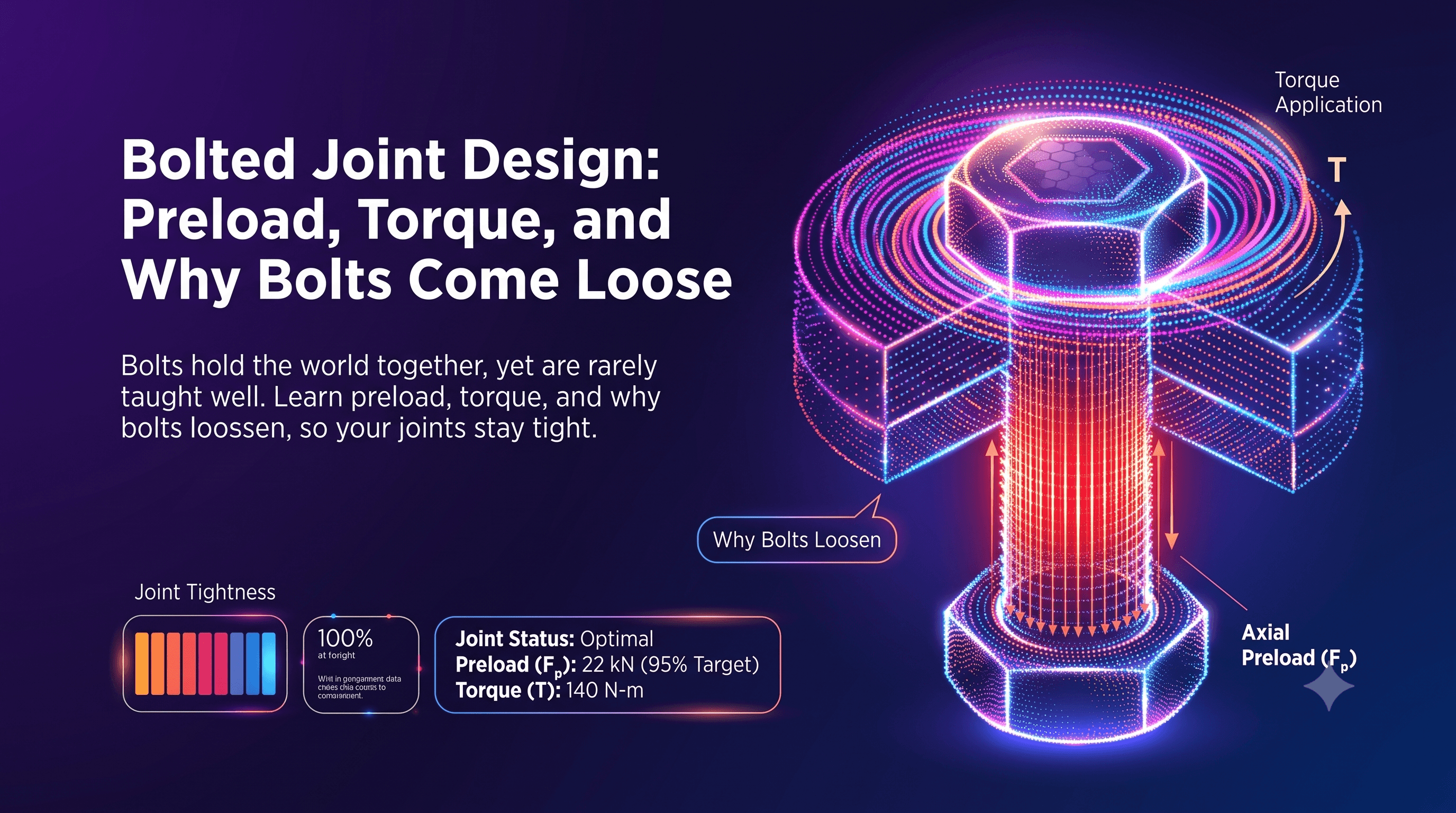
Bolted Joint Design: Preload, Torque, and Why Bolts Come Loose
Bolts hold the world together, yet are rarely taught well. Learn preload, torque, and why bolts loosen, so your joints stay tight.
On this page
Bolted Joint Design: Preload, Torque, and Why Bolts Come Loose
The most common fastener, and the least understood
What is a bolted joint?
A bolted joint is two or more parts clamped together by a bolt that has been stretched, so its tension squeezes the parts against each other.
The surprise for most beginners is that the bolt is not really there to pin the parts together like a nail. It is there to clamp them. When you tighten a bolt, you stretch it like a stiff spring, and the tension that builds up pulls the parts together hard. That clamping force is what actually holds the joint, mostly through friction between the clamped faces. Understanding that one idea changes how you think about every bolt you ever tighten.
Why it matters
Bolts hold together almost everything, yet they are taught poorly and fail often.
A bolted joint that is done wrong can loosen on its own, fatigue and snap, or let the parts slip, and these are behind a huge number of real failures. The difference between a joint that lasts forever and one that rattles loose in a week often comes down to how much the bolt was stretched, not how strong the bolt is. Getting this right is one of the most practical skills in mechanical design.
The key idea is preload
Preload is the tension locked into the bolt when you tighten it, and the clamping force it creates.
Think of the bolt as a very stiff spring. Tightening stretches it, and that stretch stores a large tension. That tension squeezes the clamped parts together with an equal force, the preload. As long as the preload is high enough, the joint behaves as one solid piece, and external loads are carried by the clamped friction rather than by the bolt itself.
This is why a well-designed joint uses a high preload. A tightly clamped joint does not separate, does not slip, and does not batter its bolt.
Torque sets preload, imperfectly
Here is the catch: you cannot measure the tension in a bolt directly, so you set it indirectly with torque.
When you tighten with a wrench, most of your effort does not go into stretching the bolt at all. The large majority fights friction, under the bolt head and in the threads. Only a small fraction, often around ten to fifteen percent of the torque, actually becomes tension in the bolt.
That has a big consequence. Because friction eats most of the torque, and friction varies with lubrication, surface finish, and dirt, the same torque can give quite different preloads. This is why critical joints use better methods than torque alone, and why a lubricated bolt tightened to a dry torque value can be dangerously overloaded.
💡 Rule of thumb: torque is a rough proxy for what you actually want, which is bolt tension. Change the lubrication and the same torque gives a different preload.
Why bolts come loose
Loose bolts almost always trace back to preload, in one of three ways.
- Too little preload. If the clamp force is weak, an external load can pull the joint apart slightly with each cycle. The bolt then feels the full swinging load and can fatigue and snap.
- Vibration. Sideways vibration can make the clamped faces slip a tiny amount, and repeated slipping lets the nut slowly rotate and back off. This is self-loosening.
- Relaxation. Soft gaskets, paint, or rough surfaces slowly embed and settle under the clamp, so the bolt shortens its stretch and loses preload over time.
The fixes follow directly: use enough preload, add a thread locker or locking feature against vibration, and design out soft materials that relax.
A quick worked example
A cover plate rattles loose in service even though the bolts are strong.
- The cause is likely too little preload. The bolts were snugged, not properly tightened, so the joint separates slightly under vibration and the nuts back off.
- The fix is to tighten to a proper preload for the bolt grade, control the lubrication so the torque gives a predictable tension, and add a thread-locking compound to resist self-loosening.
Notice that a stronger bolt would not help. The problem was never bolt strength, it was clamp force.
Common beginner mistakes
- Thinking the bolt pins the parts rather than clamping them
- Using too little preload, so the joint separates and the bolt fatigues
- Applying a dry torque value to a lubricated bolt, overloading it
- Ignoring vibration, which backs a nut off over time
- Clamping soft materials that relax and lose preload
Interview questions
Bolted joints are a favourite because the intuition is so often wrong. Here is what interviewers listen for.
"What actually holds a bolted joint together?" The preload, the clamping force from the stretched bolt. The parts are held mostly by friction from that clamp, not by the bolt acting as a pin.
"Why is torque an imperfect way to set preload?" Because most of the torque fights friction under the head and in the threads. Only a small, variable fraction becomes bolt tension, so the same torque can give different preloads.
"Why do bolts come loose?" Usually too little preload, plus vibration that lets the faces slip and the nut back off, or relaxation of soft materials that bleeds off the clamp.
"How would you stop a joint from loosening?" Use a high enough preload, control lubrication for a predictable tension, add a thread locker or locking feature, and avoid soft materials in the clamp.
Quick reference
| Idea | What it is | Why it matters |
|---|---|---|
| Preload | Tension and clamp force in a tightened bolt | It is what holds the joint |
| Torque | The tightening effort applied | A rough, friction-dependent proxy for preload |
| Self-loosening | Nut backing off under vibration | Needs locking features |
| Relaxation | Soft materials settling under clamp | Bleeds off preload over time |
Key takeaways
If you remember five things, make it these.
- A bolt clamps, it does not pin. Preload is what holds the joint.
- A high preload keeps the joint from separating, slipping, or fatiguing.
- Torque is a poor proxy for preload, because most of it fights friction.
- Lubrication changes the torque-to-tension relationship, so control it.
- Bolts loosen from low preload, vibration, and relaxation, not weak bolts.
Practice on FixtureLabs
Bolted joint intuition sticks when you reason through real ones. On FixtureLabs, work through joints that ask you to set preload, judge torque, and design against loosening.
Written by
FixtureLabs Inc.
FixtureLabs Inc. writes about fixture design, GD&T and how modern teams pair classical mechanical engineering with AI.