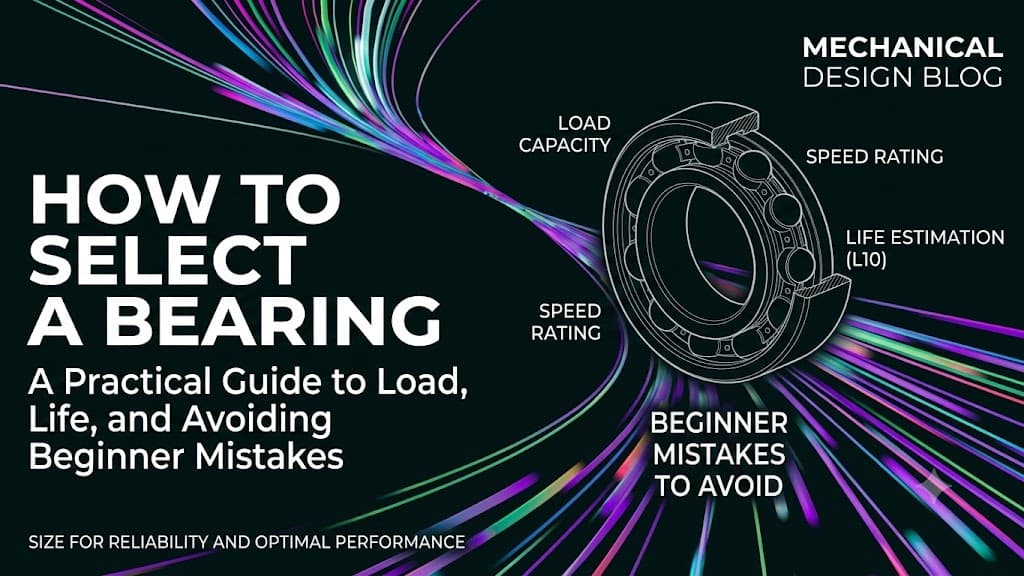
How to Select a Bearing: Load, Life, and the Mistakes Beginners Make
The right bearing depends on load, speed, and life. Learn how to choose one and avoid the selection mistakes that catch beginners out.
On this page
How to Select a Bearing: Load, Life, and the Mistakes Beginners Make
The part that lets things spin, chosen properly
What is a bearing?
A bearing is a component that lets one part rotate or slide against another with very little friction, while carrying the load between them.
Anywhere a shaft turns, a bearing is holding it in place and letting it spin freely at the same time. It has to do two jobs at once: support the load pressing on the shaft, and reduce the friction of rotation to almost nothing. Selecting one is about matching the bearing to the loads it will carry, the speed it will run, and the life it needs to last. Choose well and it runs quietly for years. Choose badly and it overheats, gets noisy, and fails early.
Why it matters
A bearing is a small, cheap part that can bring down a whole machine when it is wrong.
An under-sized bearing wears out fast. One that cannot take the load direction fails suddenly. A bearing fitted or lubricated badly runs hot and seizes. Because bearings sit at the heart of every rotating system, getting the selection right is one of the highest-leverage decisions in machine design, and one beginners often rush.
Load direction comes first
The first question is which way the load pushes, because different bearings handle different directions.
- Radial load pushes at right angles to the shaft, like the weight hanging on a rotating axle.
- Axial load, also called thrust, pushes along the shaft, like the push on a drill bit or a propeller shaft.
Most real applications have some of each. The key is that a bearing must be chosen to handle the loads it actually sees. A bearing meant for radial load will fail quickly if you push it hard along the shaft.
Different bearings for different jobs
Bearing types exist because no single design handles every load well.
- Deep-groove ball bearings are the everyday choice. They take mostly radial load with some axial, run fast, and are cheap.
- Tapered roller bearings carry heavy radial and axial loads together, which is why they are used in wheel hubs.
- Thrust bearings are built for axial load only, taking the push along a shaft.
- Cylindrical roller bearings carry very high radial loads but little axial.
Matching the type to the load direction and magnitude is most of the selection.
Bearing life and the load penalty
Bearings do not last forever, and their life depends heavily on load.
The rated life of a bearing, often called L10, is the number of revolutions that ninety percent of bearings will survive. The critical thing to understand is how steeply life falls as load rises:
- For a ball bearing, life drops with roughly the cube of the load. Double the load and the life falls by about eight times.
- For roller bearings the penalty is even steeper.
This is why a slightly under-sized bearing does not last slightly less time. It lasts dramatically less. Sizing for the real load, with margin, is what buys a long life.
💡 Rule of thumb: bearing life is brutally sensitive to load. A small overload is not a small problem, it can cut the life to a fraction.
How to select one
The process follows from the ideas above.
- Know the loads, both radial and axial, and the speed.
- Choose a type that handles the load direction and magnitude.
- Size it for the life you need, using the steep load-life relationship.
- Get the fit right, so the races do not spin, and provide proper lubrication and sealing for the environment.
Common beginner mistakes
- Ignoring axial load and picking a bearing that cannot take it
- Underestimating how steeply life falls with load
- Choosing the wrong fit, so a race spins and wears
- Neglecting lubrication and sealing, which cause most early failures
- Sizing for the average load and forgetting peak loads
Interview questions
Bearing questions test practical judgement about loads and life. Here is what interviewers listen for.
"What is the difference between radial and axial load?" Radial load pushes across the shaft, axial or thrust load pushes along it. Bearings are chosen to suit the direction they actually see.
"How does load affect bearing life?" Steeply. For a ball bearing, life drops with about the cube of the load, so doubling the load cuts life by roughly eight times.
"How would you select a bearing for a wheel hub that sees both radial and axial load?" A tapered roller bearing, because it carries heavy radial and axial loads together.
"What causes most early bearing failures?" Poor lubrication, contamination from bad sealing, and wrong fits, more often than the bearing being simply too small.
Quick reference
| Factor | What to check | Why |
|---|---|---|
| Load direction | Radial, axial, or both | Sets the bearing type |
| Load magnitude | Peak, not just average | Life falls steeply with load |
| Life | Revolutions needed | L10 rated life |
| Fit and lubrication | Correct fit, sealing, grease | Prevents most early failures |
Key takeaways
If you remember five things, make it these.
- Decide the load direction first, radial, axial, or both.
- Match the bearing type to that load direction and size.
- Bearing life falls steeply with load, roughly the cube for ball bearings.
- Fit, lubrication, and sealing cause most early failures, so get them right.
- Size for the peak load with margin, not just the average.
Practice on FixtureLabs
Bearing selection sharpens with real cases. On FixtureLabs, work through problems that ask you to weigh load, speed, and life and choose a bearing that lasts.
Written by
FixtureLabs Inc.
FixtureLabs Inc. writes about fixture design, GD&T and how modern teams pair classical mechanical engineering with AI.